SHRI SHIVAJI VIDYA MANDIR & JR. COLLEGE, AUNDH, PUNEAdmissions Open For V TO XII Classes SALIENT FEATURES OF THE SCHOOL AND JUNIOR COLLEGE--1. Qualitative Education 2. Qualified Teachers 3. Well-equipped Laboratory 4. Excellent vocational and career guidance 5. Safe and secure campus 6. Value based education 7. Clean and healthy environment 8. Conduct free medical check-up 9. CCTV cameras in the premises 9. Well-maintained library

Sunday, 10 July 2022

4.1 History of Novel


4.1 History of Novel 

The activities on the chapter 'History of Novel' can be set as follows-
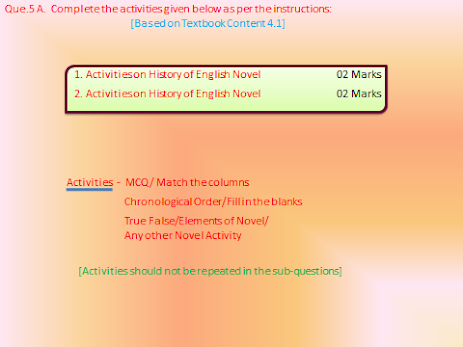
Activities based on History of Novel

From section four, the chapter 4.1 History of Novel is a description of the origin and development of the novel. Novel is the most popular famous literary genre. It describes the growth and evolution of this genre and also lists names of many masterpieces and their writers.


The eighteenth century has gifted the English literature two new forms- The Periodical Essay and The Novel. Novel got the spirit of eighteenth century as intellectual , sentimental and realistic plane and tried to instruct the readers. Since the time of origin, the novel has been growing and gaining its popularity.


Activities- 

1. The eighteenth century has gifted the English literature two new forms........ 

a. Poetry and Drama   b. Short story and Drama   c. The Periodical Essay and Novel    d. Greek Romances and Novel


2. The Periodical Essay and Novel emerged as new forms in.......century.

a. Sixteenth         b. Seventeenth       c. Eighteenth      d. Nineteenth 


3. Today ...................is recognized as the most dominant literary genre.

a. Drama       b. Novel      c. Poetry     d. Greek Romances


4. Novel is written in the form of .......

a. prose   b. verse     c. rhythm


5. The word 'novel' is derived from the word.........

a. novelist       b. novella      c. new     d. narrative


6. The word 'novella' means.......

a. short       b. long       c. new     d. narrative


7. Novel creates a picture of ........of that time.

a. forest        b. city        c. society       d. characters


8. ............makes life easier to understand than drama and poetry.

a. Novel     b. Short Story     c. Greek Romances    d. Newspaper


9. The novel has a history of about.......years.

a. three thousand     b. two thousand      c. four thousand  d. five thousand


10. Greek Romances existed in between.........century.

a. 2 and 6     b. 3 and 5     c. 1 and 4      d. 6 and 9


11. ...........is the world's first novel.

a. Tale of Genji    b. Don Quixote    c. Ecologues    d. Oroonoku


12. The Spnish writer........created the first European novel.

a. Geoffrey Chaucer  b. Miguel De Cervantes    c. Virgil    d. Aphra Behn


13. The novel 'Don Quixote' was published into ........parts.

a. two     b. three     c. four      d. five


14. In England, novel originated as a literary form after........

a. 1745       b. 1740      c. 1840      d. 1845

15. .........people regarded novel as respectable reading material.

a. Old     b. educated   c. illiterate   d. young

16. There are ............elements essential of 'Novel' or 'Novella'.

a. seven     b. five       c. six 

17. Theme is the .............in the novel which can be expressed in a nutshell.

a. central idea        b. conclusion      c. introduction

18. In the first half of the 20th century, a cult of ............ magazines' became popular.

a. amazing           b. pulp        c. powerful

19. Space travel, time travel and extraterrestrial life may be seen in ..............fiction.

a. historical          b. gothic      c. science

20. The word 'picaresque' is originated from the Spanish word.......

a. novella    b. gothic      c. picaro  


State whether the following statements are true/false. Correct the false statements and rewrite them.

1. The eighteenth century has gifted Drama and Novel.

False-The eighteenth century has gifted 'The Periodical Essay' and 'Novel'.

2. The novel is a long narrative fiction.

True

3. The novel is written in the form of verse.

False-The novel is written in the form of prose.

4. The word 'novel' is derived from Spanish word 'novella'.

True.

5. The word 'novella' means 'new'.

True.

6. Drama and poetry make life easier to understand than novel.

False-Novel makes life easier to understand than drama and poetry.

7. Greek Romances included stories of ideal love and marvellous adventures.

True.

8. Ecologues is a creation by Virgil.

True.

9. Murasaki is the world's first novelist.

True.

10. The middle class was attracted to newspaper and magazine in 18th century.

True.

11. The middle class in 18th century was interested in the romantic features.

False-The middle class in 18th century denied romantic features.

12. Industrial revolution had given risen to middle class.

True.

13.Aspirations and longings of middle class and lower class seemed to be presented in the novel.

True.

14. The word 'epistolary' derives from the Latin word 'epistola'.

True.

15. The surface and symbolic meanings are similar in Allegorical  novel.

False-The surface and symbolic meanings are different in Allegorical  novel.


Pick out the odd element from the group.

1. Arun Joshi, Vikram Seth, Graham Greene, Kiran Nagarkar

2. Place, Period, Theme, Climate, Lifestyle

3. Theme, Plot, Character, Novella

4. Billy Budd, The Turn of The Screw, Pearl, Joseph Conrad, Death In Venice


Match the columns:

A

B

1.  Murasaki Shikibu c

a.  Cervantes

2.  Novella d

b.  Bankim Chandra Chattopadhyaya

3.  Don Quixote a

c.   Tale of Genji

4.  Rajmohan's Wife b

d.  New


A

B

1.  Virgil b

a.  Morte De Arthur

2.  Malory a

b.  Ecologures

3.  Daniel Defoe d

c.   Oroonoku

4.  Aphra Behn c

d.  Robinson Crusoe


A

B

1.  Gothic d

a.  Agatha Christie

2.  Stream of consciousness c

b.  Mary Ann Evans alias George Eliot

3.  Psychological insights b

c.   Virginia Woolf

4.  Crime a

d.  Ann Radcliffe


A

B

1.  Theme c

a.  The struggle between the opposite forces in the story

2.  Style  d

b.  The background in which the story takes place

3.  Setting b

c.   The central idea in the novel which can be expressed in a nutshell.

4.  Conflict a

d.  The language and the techniques used for the narration of the course of events.


A

B

1.  Jonathan Swift d

a.  Evelina

2.  Samuel Richardson b

b.  Pamela

3.  Mary Shelley c

c.   Frankenstein

4.  Frances Burney a

d.  Gulliver’s Travels


Other activities-

1. Write a note on stream of consciousness novel.

2. Write a note on style of novel.

3. Define a term 'Novella'.

4. Write about epistolary novel.

5. Indian tradition of novel.

6. Write a note on psychological novel.

7. Write a note on autobiographical novel.

8. Write a note on utopian/dystopian novel.

Compiled By-Dr. Salunkhe T. B.


Thursday, 30 June 2022

Saturday, 25 June 2022

2.1 Song of the Open Road-Walt Whitman


Read the following extract carefully and complete the activities given below it. 
Afoot and light-hearted I take to the open road,
Healthy, free, the world before me,
The long brown path before me leading wherever I
choose.
Henceforth I ask not good-fortune, I myself am
good-fortune,
Henceforth I whimper no more, postpone no more,
need nothing,
Done with indoor complaints, libraries, querulous
criticisms,
Strong and content I travel the open road.
The earth, that is sufficient,
I do not want the constellations any nearer, I know they are very well where they are,
I know they suffice for those who belong to them. (Still here I carry my old delicious burdens,
I carry them, men and women, I carry them with me wherever I go,
I swear it is impossible for me to get rid of them,
I am fill’d with them, and I will fill them in return.)

A1-Point out the adjectives describing that the poet enjoys his journey.
1...................................
2...................................
3....................................
4...................................
A2-By 'old delicious burdens' the poet means-
a. the luggage
b. the food he carries
c. the stress he bears during the travels
d. sweet memories of the past
A3- 'Healthy, free, the world before me'. Express your views regarding this line.
A4-Pick out two lines of the figure of speech Alliteration.
A5-Compose four lines of your own on the topic 'The road that leads to my college'.


Answers-
A1-
1.light-hearted
2. healthy
3. free
4. strong and content
A2-
d. sweet memories of the past 
A3-
The poet has started his journey of life. He may come across a lot of obstacles on his way. But he is enough strong to face the challenges he may have to face in the journey. The line also reveals the fact that the poet has the positive attitude to look at the world. The poet seems to be optimistic and hopeful. 
A4-
Examples of Alliteration
The long brown path before me leading wherever I
choose.
Henceforth I whimper no more, postpone no more,
need nothing,
A5-
I go everyday to my college,
On the road that leads to knowledge.
Always hopeful with the thought,
That inspires me for the future bright.

Write an appreciation of the poem.
1. About the title-
The title 'Song of the Open Road' is a appropriate as the words in the title like 'open' and 'road' themselves express the theme of the poem. The title reveals the poet's optimism and also describes his journey of freedom and independence. Moreover, the poet shares his experience of travelling on the road with joy, therefore the poem is rightly entitled as a 'song'.

2. About the poet-
Walt Whitman is an American poet who is known as 'The Father of Free Verse'. He grew up in Huntington in a family with difficult economic status. The poem 'Song of the Open Road' is taken from Whitman's major work 'Leaves of Grass'.

3. Theme of the poem-
The poem mainly deals with optimism and freedom. The speaker of this poem is the poet himself and feels free as he wants to go anywhere. The poem also suggests the readers to explore the world with our abilities and opportunities. The poet has aptly pointed out that one should travel the journey of life leaving the past behind happily. 

4. Poetic Devices in the poem-
The poet has used variety of poetic devices in this poem. The poet has made use of different figures of speech to express his thoughts effectively. 'Afoot and light-hearted I take to the open road', 'Strong and content I travel the open road' these lines are examples of the figure of speech 'Inversion' because the poet has changed the proper word order. 'The long brown path before me leading wherever I choose', 'Done with indoor complaints, libraries, querulous criticisms' are examples of the figure of speech Alliteration because in these lines the sounds 'l' and 'n' are repeated respectively. 

5. Focusing elements in the poem-
The poet has used free verse style so that he can express his thoughts freely without using the rhyming words. This poem is dramatic monologue. To enhance the effect and importance of his views, the poet has used repetition of certain words and phrases in this poem. 

6. Message, values, moral in the poem-
'Song of the Open Road' is an inspirational poem as it encourages the readers to lead happy and free life. It also teaches us that one should be always optimistic and have positive attitude to look at the life and world. From the poem, we can learn that we should not expect anything from others and we should be self-confident and content.
                                             *********************

Compiled By-Dr. Salunkhe T. B.


Oral Examination-Key Information

English Language Department (Annual Oral Examination-2023-24) The format of oral exam given below is in the subject of English language....